
Quality, trust and the standard we set
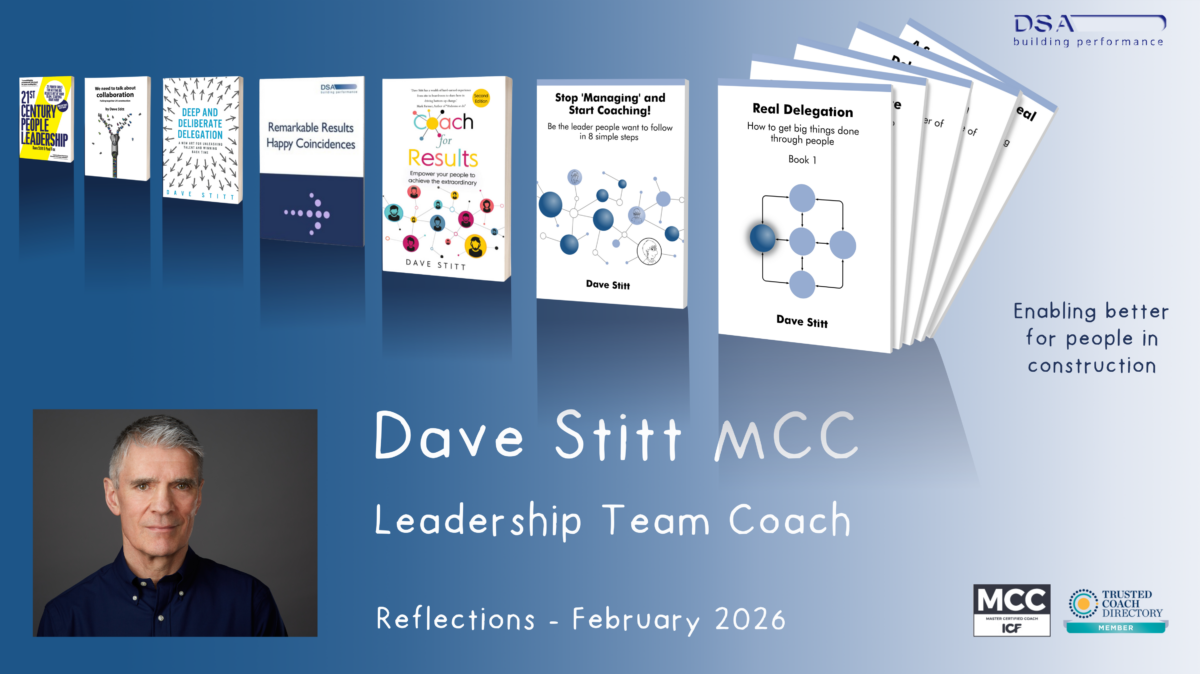
Reflections from my February LinkedIn posts and conversations on the long game in construction
After five decades in construction – and 25 years coaching executive teams – certain themes return to me again and again.
Trust. Quality. Standards. Commitment. Language. Direction.
None of them are new. Yet they remain live issues in boardrooms and on projects across our industry.
Here’s some reflections drawn from recent conversations and my LinkedIn posts –observations from practice rather than commentary and instructions – that may be useful as you think about your own leadership work.
Delegation is always about trust
Delegation appears in almost every conversation I have with executives.
The word itself may not be used, but the issue is there.
Work not flowing. Leaders overloaded. People underused. Decisions stuck at the top.
To delegate is to en-trust someone to get something done. Trust sits inside the word.
That is why I created the Trustworthy Tracker in my book Deep and Deliberate Delegation. It is a simple framework for asking: is this person worthy of my trust for this task, at this time?
Deliberately rather than sentimentally or blindly.
Delegation with your eyes open.
And the useful twist is this: the framework can also be turned on yourself. How trustworthy are you? Do you do what you say? Do you follow through? Do you model consistency?
Everyone talks about trust, though it’s trustworthiness that counts.
Self-awareness and the weight of leadership
A colleague recently said to me, “Delegation is to executives as weightloss is to Americans. They know they need to do something. They try. They struggle. They revert.”
It made me smile – and wince.
Senior leaders are typically highly self-aware. They know when they are overloaded. They know when they are holding on too tightly. They know when their teams could step up further.
But knowing and doing are different.
Better begins with self-awareness, yes – but it also requires deliberate shifts in belief and behaviour. That takes time, repetition and humility.
Not hype.
Hype is a trap. Better is better.
When I read a line from Seth Godin – ‘Hype is a trap. Better is better.’ – it stayed with me.
I notice how easily words escalate.
‘Delighted’ becomes ‘absolutely delighted’.
‘Improvement’ becomes ‘transformation’.
And once language is turned up high, expectations follow.
In construction, ‘transformation programmes’ are announced with conviction. The implication is permanent, fundamental change – the caterpillar becoming the butterfly.
In reality, they settle for better versions of what they already were. They remain contractors – just more capable ones.
That is not failure. That is progress.
In coaching, I have never transformed a person into something else entirely. What I have seen is clearer thinking, shifts in perspective and sustained effort over time.
Better compounds.
Hype inflates and then disappoints.
The art of apology
I found myself reflecting recently on apologies.
Some apologies are felt and forgiven. Others land flat.
What makes the difference?
Perhaps it is the willingness to be at cause in the matter. To take responsibility for one’s part and acknowledge consequences – sometimes costly.
In leadership teams, this is a big thing. The tone set at the top shapes how safe it is for others to admit error.
In construction, where complexity is high and pressure constant, mistakes happen. The quality of the apology often influences whether learning and integrity follows.
Hesitation and commitment
I nearly didn’t race recently. I felt slightly off – tired, not quite right.
There was hesitation.
I have a long-held belief: where there is hesitation, there is no commitment.
Leadership feels similar at times. The standard is declared – Zero Defects, Right First Time – but privately there is doubt.
Commitment is rarely loud. It’s quiet and steady. It shows up in preparation, in prevention, in conviction and follow-through.
Zero Defects and the standard we set
Years ago, in a main board meeting, the CEO asked me whether we were getting everything right first time on all sites.
I said no. It’s complex.
He told me to sort it – with full support, and he held eye contact with everyone in the room.
The performance standard was clear.
The concept of Zero Defects was introduced by Philip B. Crosby in the 1960s. His Third Absolute: The Performance Standard is Zero Defects.
Not as an outcome guarantee, but as a standard.
He argued that people perform to the standard they are given – provided they understand it.
In construction, we often debate whether Zero Defects is possible. Some redefine it. Some declare it achieved at handover. Others dismiss it entirely. I think we are missing the point.
The deeper question is this:
What standard are we truly setting? And do we believe it ourselves?

DeliverStart2Finish ™
Building and sustaining the team for the duration so it delivers remarkable results in a remarkable way.
Quality as an ethical matter
In a paper I wrote in 2002, inspired by Crosby’s Quality Without Tears, I explored his Four Absolutes of Quality:
- Quality is Conformance to Requirements.
- The system of quality is Prevention.
- The performance standard is Zero Defects.
- The measurement of quality is the Price of Nonconformance.
‘Conformance to requirements’ sounds straightforward until we ask: whose interpretation of the requirements?
Prevention – planning quality in, rather than inspecting defects out – remains as relevant now as it was decades ago.
And then there is the Price of Nonconformance: the cost of everything that would not need to be done if everything were done right first time.
One Tier 1 contractor once calculated they were effectively building 1.2 projects for every client. A cost of quality of 20%.
That cost is largely invisible. It is built into tenders, work rates and margins.
Ultimately, clients pay for it. Contractors absorb it. The industry normalises it.
The opportunity for better remains substantial.
Regulation, obedience and care
There are increasing calls for more legislation.
My experience of regulation is mixed. Compliance can create order. It can also create resentment and gaming.
When quality becomes purely an ethic of obedience – ‘tell them what to do and check them for compliance’ – people disengage. They comply outwardly and disconnect inwardly.
Quality, in my experience, is about care.
Care for the work.
Care for the client.
Care for reputation.
Care for each other.
Care cannot be legislated into existence.
It is modelled. By us.
Providing direction: Finding North
In leadership team development work, I often begin with a simple physical exercise: find North.
The insight that follows is common. People are working hard, but not necessarily in the same direction. They don’t know where North is.
When asked to articulate ‘North’, leaders initially offer the standard answers: safety, on time, profit.
Then someone usually says, “There’s more to it.”
The conversation deepens.
Alignment takes time. It is a process, not an event. It advances and slips back. It requires repetition.
But when a leadership team genuinely agrees on North – and consistently points towards it – effort becomes traction.
Easy substitutes and the hard work
Occasionally I hear: “We do our leadership team development in-house now. It’s easier.”
It may well be.
To facilitate is to make easy, but leadership team development is rarely easy. It involves surfacing what is unsaid. Naming tensions. Challenging patterns.
An internal facilitator may find that difficult – particularly if they are part of the same system.
Easy substitutes exist for most worthwhile endeavours.
The question is not whether they are cheaper or more convenient. The question is whether they produce joined-up leadership and sustain it over time.
Pandiculation and using the brain
I recently came across the word pandiculation – actively engaging the brain to release tight muscles.
It struck me as a useful metaphor.
In leadership, where are we stretching harder when perhaps we need to engage more deliberately?
How might conscious attention release tight patterns in teams – habitual reactions, entrenched silos, repeated misunderstandings?
Sometimes the next level of performance does not require more force. It requires more awareness and always more engagement.
It’s a team effort
Even this article – like most things – is not a solo endeavour.
Behind any published piece sits thinking partners, editors, designers and quiet support.
Leadership is similar.
Influencers may appear to operate alone. In reality, there is usually a machine behind them.
Construction projects are no different. Success is collective.
Perhaps that is obvious. It is also worth remembering.
Where this leaves us
Across trust, delegation, quality, language, standards and direction, a common thread runs:
Leadership is deliberate practice.
It is setting standards and living them.
It is choosing words carefully.
It is preventing rather than repairing.
It is aligning effort.
It is caring for the work.
It is integrity.
If you are leading a major project or business right now, you carry significant weight. You do not need more hype.
Perhaps it’s enough, occasionally, to pause and ask:
- What standard are we really setting?
- Where is the Price of Nonconformance hiding?
- How aligned are we on North? Even better, are we agreed on North?
- Are our words raising expectations we cannot sustain?
- Where might ‘better’ be more honest than ‘transformational’?
There is still room for better.
Quietly. Steadily. Over time.