
Why Quality needs to be the first item on the agenda: reflecting on 50 years in construction
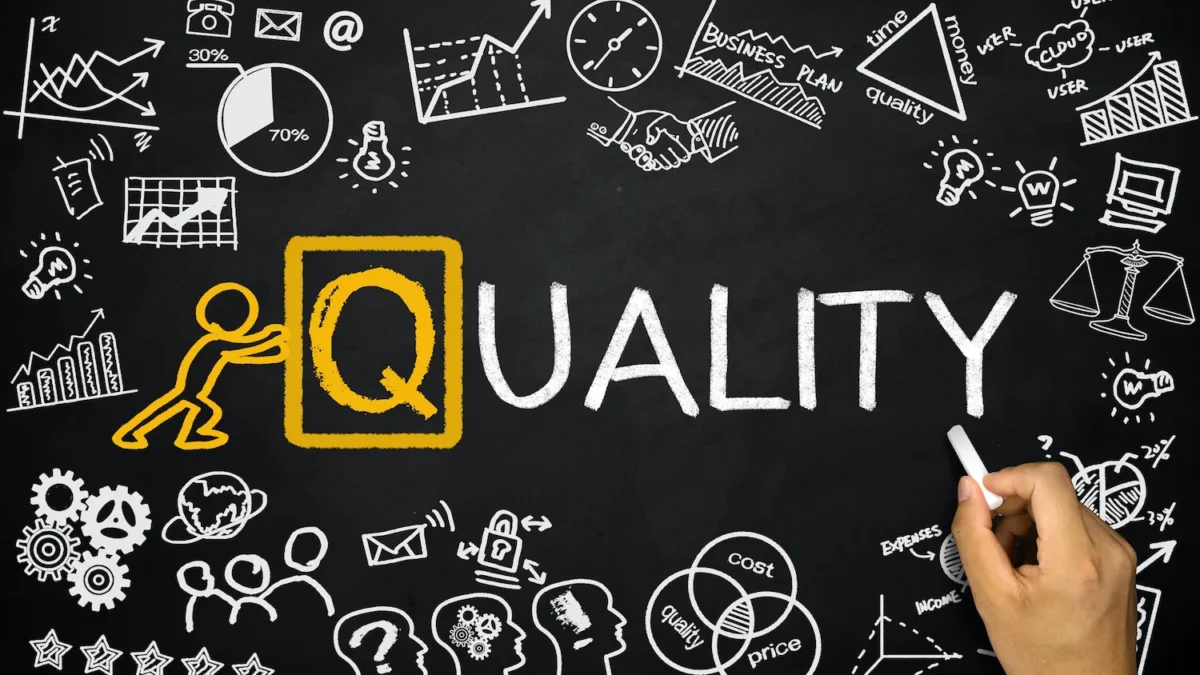
There’s talk about Quality. Mostly what I hear, it’s about them over there – other people. It’s about the product, particularly defects or what’s gone wrong and what we’re going to do to put it right and make sure it never happens again.
Here, I’d like to broaden it out …
There is a Hindu story where the little fish asks his mother fish, I have been anywhere and everywhere, but I cannot find this thing called water. Quality is the water that supports us all. It is the source of both subjects and objects, both mind and matter. It is everything.
– Robert M. Pirsig
And I’d like to bring it back to me, rather than them over there. What’s the quality of my work, business relationships, meetings, coaching, leadership, response in the moment, communication, engagement, how I show up, the environment I create … and indeed me as a person?
This is a big conversation. Perhaps, for us all.
Why me, and why now
I unwittingly made my first Quality intervention the day I started work. That was 1976 and I was sixteen. After making the big boss his cup of tea, he told me to “go and have a look at that concrete pour and see what they’re doing”.
Donning my new boots, not-so-Hi-Viz coat and helmet, I walked over and, clueless, asked one of the blokes, “What you doing?” He stopped, looked down, then at me, and said, “Fair cop.” He then started blowing out debris from in front of the concrete with a very noisy hose.
Still clueless, I went back and told the big boss, and he said, “Good job, David.”
Fifty years on, my daily Quality interventions have continued right up to this very day, with this article.
In the years between then and now I’ve done all the usual site Quality Control checks and adjustments, without QA or Inspection and Test Plans – they came later. I’ve created operational systems for others to implement. I’ve led award-winning, company-wide, so-called ‘transformation’ and best-practice programmes; had papers and articles published in learned places; and was Chairman of an industry-wide initiative, for one day, prior to it being abandoned – on my suggestion.
And I’ve read some great, and not so great, books on the subject.
It’s from recently re-reading Zen and the Art of Motorcycle Maintenance by Robert M. Pirsig – probably for the fifth time – that I’m inspired to get my 50 years of ‘quality’ thinking down now. I’m giving it my best; you can judge its quality.
What’s motorcycle maintenance got to do with construction Quality and Zen?
Without any explanation, Zen and the Art of Motorcycle Maintenance was on the reading list for the first year of my Civil Engineering degree at Hatfield Polytechnic in 1980. It was published in 1974.
I tried to read it but didn’t understand it, nor could I figure out what it had to do with civil engineering. No more than a third of the way through, I put it down and gave up on it.
There were other seemingly esoteric books on the list – about the North–South divide, Small Is Beautiful, and A Guide for the Perplexed – which I struggled through and made little sense of. I had the lecturer down as a bit of an old hippie, though I’ve long since thought he was way ahead of his time and was onto something big – maybe what really matters.
Strangely, to me anyway, I picked up the book ten years later, and then again and again every half-dozen years or so, and now love it on so many levels. I now think I know what it has to do with civil engineering and building – and everything about what I do and who I am as a person. It is Quality.
Thinking differently about Quality
Over the years, I’ve been asked to sit on various committees in the construction industry, each time with a call to think differently about Quality. I have gracefully, I hope, declined most, primarily because I’m a poor-quality committee member.
I prefer to think out loud, like here, publish and hope that a few people are inspired, rather than talk endlessly round a big table with no one listening. And I don’t see much evidence of improvement in either method or product, which makes me wonder about the quality of the thinking and output.
So, thinking differently about Quality, I’d like to turn to philosophy and ethics, because I’ve come to think of Quality as an ethical matter worth thinking deeply about – particularly in construction at this time.

DeliverStart2Finish ™
Building and sustaining the team for the duration so it delivers remarkable results in a remarkable way.
What’s philosophy got to do with civil engineering?
Zen and the Art of Motorcycle Maintenance is a beautiful, real-life story about a father–son relationship, and much more. It’s about love, education, mental health, self-reflection and a deep dive – for me anyway – into philosophy about Quality.
In recommending the book, maybe my degree lecturer was prompting me to think deeply about philosophy, or to gain practical insights that would shape the quality of my education, my career and even me as a person. Here, I’m going to focus on practical insights – mine at least.
Reading the book over the years, and living my life in construction, I’ve come to believe quality has much to do with caring, peace of mind and gumption – it’s very much a ‘people thing’.
Pirsig says that ‘care and quality are internal and external aspects of the same thing’. Two sides of the same coin. He goes on to say, ‘A person who sees quality and feels it as he works is a person who cares’.
When discussing Quality I say, show me a person who cares and I will show you quality work. Show me quality work and behind it I will show you a person who cares. I think I got that from Pirsig.
And to care, I need peace of mind – to be ‘at one’ with myself and my surroundings.
Peace of mind produces right values, right values produce right thoughts. Right thoughts produce right actions and right actions produce work which will be a material reflection for others to see the serenity at the centre of it all.
– Robert M. Pirsig
Looking back, my work suffered when I was upset or bored, disengaged, freezing cold and wet, hacked off with myself or others. And pushing through was exhausting and took its toll. Peace of mind matters to caring.
And Pirsig talks about ‘gumption’, a word that seems to have all but dropped out of use. He shows the root word to be ‘enthusiasm’ – I would add ‘spirited initiative’ and ‘resourcefulness’.
If you’re going to repair a motorcycle, an adequate supply of gumption is the first and most important tool. If you haven’t got that you might as well gather up all the other tools and put them away, because they won’t do you any good.
And there are ‘gumption traps’ that deplete this spiritedness – some mentioned immediately above, and more, such as rules and procedures that add burden.
Rules and regulations imposed from above and externally can seriously deplete gumption. I’ve become increasingly concerned about this over many years. Is it human nature that when something goes wrong, we layer on more prevention to ensure it never happens again? It seems so to me. Is this an ethical matter?
Quality is an ethical matter
I would never have thought so; though now I’m convinced it is. Quality is an ethical matter.
As a construction professional, I did not read the Code of Ethics from the day I became Chartered until recently, when I compared that code with the one I operate under as a coach.
As a coach, I consciously uphold the Code of Ethics throughout every coaching engagement, before and after. Struggling with the level of rigour involved, I asked my coach mentor, and she suggested I read Roger Steare’s ethicability®. It’s an important book that I recommend to construction professionals, their employers and institutions.
In simple (it’s not at all simple) terms, ethics helps us decide what’s morally right and why, and to resolve various types of conflict. In his book, Steare describes the three dominant philosophies: the Ethic of Obedience, the Ethic of Care, and the Ethic of Reason.
The Ethic of Obedience is defined by our legal rights and duties – and what the boss says. The Ethic of Care is about doing the best for the greatest good. And the Ethic of Reason is about thinking and reasoning for ourselves to work out what is right.
We need all three ‘moral consciences’, though I fear the balance has shifted heavily towards the Ethic of Obedience and associated compliance. At all levels, people are told what to do and how to do it. There is a tragedy, and new laws with unimaginable consequences are imposed. The organisation loses money on some projects and beefs up procedures for all, adding to the weight of burden. A project leader discovers malpractice and imposes new strictures; HR find out and secure policy ‘enhancements’ company-wide.
Checking for compliance has become a key management function. Obedience is the priority.
In his brilliant book Drive, Daniel Pink sets out compelling evidence that people are motivated by autonomy, mastery and purpose. In my experience, people resent being told what to do and how to do it. They want to think and reason for themselves, rather than being over-regulated, obedient and compliant.
Though it seems obedience and compliance are the way of things, and it is destroying gumption. People are disengaged – check Gallup State of the Global Workplace Report 2025 – and they care less for their work; they literally become careless.
This reliance on obedience is why Quality is an ethical matter; it is also a leadership matter.
Quality is the first item on our agenda
I believe leadership is about ethics. And providing direction, and creating an environment where everyone can come to work and do their best work. When everyone cares for, and is able to do, their best work, then magic happens – Quality.
Currently, Quality is the domain of the QA manager, and it’s about method. What if the board of directors declared, ‘Quality is the first item on our agenda’, from a deep knowing that it’s what happens in here that leads what happens out there?
This is me thinking differently about Quality. That would be leaders thinking differently about Quality.
We need to talk about Quality.
An edited version of this article was recently published in CIOB People