
Digging Deeper on Teams – reflections from my May LinkedIn posts
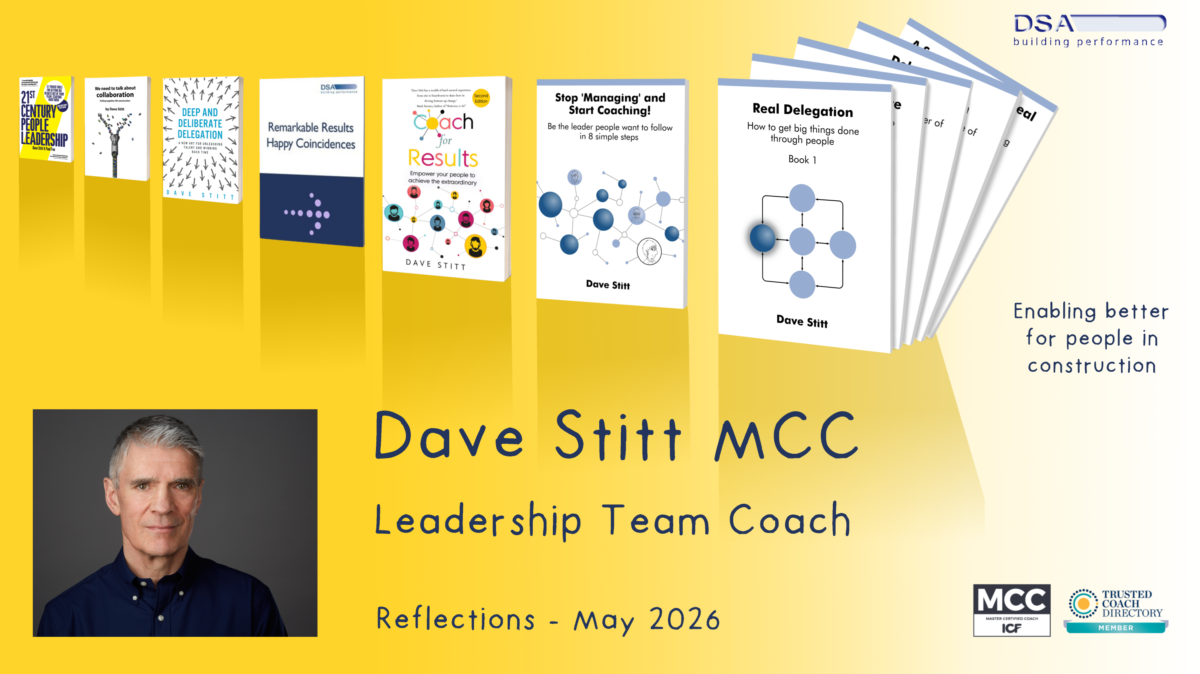
Dave Stitt MCC
Leadership team coach and content creator
June 2026
Introduction
Each month I pull my LinkedIn posts together in a long-form article. In April, I talked about my work as a leadership team coach, establishing and sustaining effective team working at that level. And why that is so important for big business and big construction projects.
In May, I dig deeper into the detail of this work. Executives leading or working in a dysfunctional team will find this article useful. If that is you, it may prompt you to get a coach and it will give you a good idea what to expect if that coach happens to be me.
All leadership teams are dysfunctional; for me, that is plain to see though probably not for you – in it, too close to it. Reading this article will raise your awareness and once aware you will have to take responsibility.
Reach out to me if you will. This is my work.
In June, I am celebrating and posting on my 50 years in the construction industry – very much looking forward to that.
Pointing north, together
In my work with leadership teams, an early activity involves getting everyone to point north, or more accurately, enabling them to agree where north actually is for them.
For a board of directors, that might mean what success looks like at the end of their business cycle. For a project leadership team, it’s usually project success – what that means, what it looks like when they get there, what will be different.
Before we can even begin that conversation, though, there’s preliminary work. These are very busy people. Each arrives with their own pressures, drivers and individualities. Unless that is somehow recognised, they are unlikely to be fully present. Their body is in the room but their head is somewhere else. When that happens, their contribution to defining success will be partial at best – and that will show up later, inside and outside the room, when it counts.
So I ease them in first. That does not mean an icebreaker at the start of the day. It can take weeks, even months. On the day itself, we might do something to get everyone’s voice in the room, but the real easing in happens over time as they settle into the work and into each other.
Once the leadership team members are all pointing north, they then have to go out into their organisation or project and get everyone else pointing north too.
Sometime later, they lose focus on where north is. So we rinse and repeat. I have found 90 days to be the optimum interval for refocus.
It’s a recursive process. From start to finish, for best results.
The opportunity few will get
When I’m coaching a project leadership team, I look into the room and see future members of the main board. Literally. It has happened many times. I have been around long enough to witness it.
For those people in the room, this is a rare opportunity to learn how people of difference, with different drivers, come together and form themselves into a joined-up leadership team. Over time they get to see and feel what that looks like, what it feels like and what its positive impact is.
Their success on this project contributes to their personal reputation for delivery. That moves them towards the main board.
When they get appointed to the board, they already know what a joined-up leadership team looks like and feels like, how to get there and stay there. That experience enables them to contribute at this higher level. Sometimes they go on to lead the main board. That board goes on to become an effective leadership team and makes an impact – reputation, legacy.
What an opportunity. Most people do not get to have this.
Rigour means agreement
I was working with a newly formed project leadership team. The MD had just won his biggest and most challenging project. Rigour was one of his values – he wanted this project delivered right. The client valued collaboration; he’d been burnt before and really wanted to work this one together.
They agreed to set up a leadership team of six senior people, three from each side. Their brief was ‘collaborative delivery with rigour’.
I enabled the team to work out what they meant by ‘collaboration’. This took a while. They all had different angles on it and experiences to boot. They got there eventually. They agreed what collaboration means.
Then I challenged them to set standards. Five-star collaboration is… four-star, three-star, two-star, one-star. They debated and finally agreed a description for each. Five-star was what they were aiming for. One-star was mediocre, the norm in their experience. They were getting to know each other here and were up for it.
I asked them how they were going to evidence it along the way. They looked at me as if I was daft. I said “rigour”. They dug in and worked it out together and reached agreement.
One of them said, “Have you noticed we seem to be collaborating on this?” Another said, “Yes, three-star,” and matched it to the evidence. They all laughed and one shared how she thought they could move to four-star.
This is collaboration according to their definition and it has rigour – they have agreed what collaboration is to them, set standards and know how to evidence them.
They have started. Now they need to sustain it right through to the finish.
Rigour needs agreement. Alignment will not do. Alignment lacks rigour.
Speaking plainly about what is at stake
I work with big business and big project leadership teams in the construction industry. At my entry point, these talented team members have different drivers and are working in silos. They say they are a good team – “we get on fine” – but messaging is mixed and uncoordinated. Some tell me they are working below their pay grade and want to step up and lead together rather than ‘do’ on their own.
If nothing changes, it will cost them in personal frustration, widespread confusion, disengagement through the ranks, sometimes a toxic environment, fading commitment, low morale, staff churn, poor productivity, claims, counter-claims, disappointing results, stalled careers and worse. If nothing changes, it is more of the same.
Through my coaching, they become joined up as a leadership team, pointing in the same direction and leading accordingly. And as my team coaching is a process rather than an event, they work on sustaining their collective effectiveness from start to finish.
When they follow the process, do the work and stay the course, they deliver remarkable results in a remarkable way. Their reputation for delivery is enhanced and many go on to realise and even surpass their career aspirations. Again, I have been around long enough to have seen it.
For my clients, that’s worth millions, enhanced company brand and personal reputation, career success and legacy. For regional directors, project directors and CEOs in major contractors and joint venture projects, this also means more control, life balance and stronger confidence in their leadership team.
If you are leading or are in a team that feels a bit off, or are about to embark on something magnificent and want to nail it, then I am speaking plainly to you.
Three questions for working on the team
When a big project is finished, the client and the board always tell a story about how the leadership team behaved under pressure.
They say things like “they were calm and straight with us, even when it was grim” or “they frequently turned on each other” or “they led as one team right through to the end”. The story is being written now in how you and your team show up.
What story do you actually want them to tell? And if someone watched your leadership team for the next month, would they see that story in your behaviour? In how you handle bad news, how you talk about the joint venture partner or the board, how you talk about people when they are not in the room?
In my experience, leadership teams do not stop to ask that. They are flat out delivering – they cannot step back and look at themselves.
The other thing I see is people trying to learn everything the hard way. Working out the culture, politics, unwritten rules by trial and error. I see it in what is brought to coaching. It is costing them in time, energy and reputation.
As a coach, I am not listening for that stuff. You and your team are the project experts. My job is different. My job is to enable the sort of conversations that never happen on their own – focused on how you are leading together rather than about the project, its problems or politics.
I’ve been in this industry for 50 years and coaching leadership teams for 25. I’ve seen the same patterns play out repeatedly on big projects. I do not have answers. Rather, what I bring is a way of working that makes it easier for your answers to emerge, grounded in your reality.
Another question for a project leadership team: “If we change nothing about how we lead this project over the next year, what is most likely to break first – and what will that cost us?”
Sometimes they say relationships with the client, or trust inside this team, or people’s health, or safety, or quality. Whatever it is, once you’ve named it, you can decide what you want to do about it. You already know about the cost. You’ve been here before.
If you are leading a big project right now, you could take an hour this week and ask your team these three questions:
- What story do we want the client and the board to tell about how we led this project under pressure? Told after the job has finished.
- Are we behaving in line with that now?
- If we do not change anything about how we lead, what is most likely to break – and what will that cost us?
If you do ask them and find the team gets stuck or goes round in circles, that could be the work. If you hold the conversation and it goes well, good on you. You are working on the team.

DeliverStart2Finish ™
Building and sustaining the team for the duration so it delivers remarkable results in a remarkable way.
Doing the work
If the leadership team I am coaching follows the process, does the work and stays the course, they will deliver remarkable results in a remarkable way.
What does ‘doing the work’ actually mean?
But first, let’s talk about ‘remarkable’. Excellence is boring. To thrive nowadays, you need to be remarkable. As in remark-able – lots of the right people remarking, saying great things about you. Word of mouth, reputation is where it is at these days. Remarkable sounds like hype but it is real, doable and essential.
So, what does ‘doing the work’ actually mean for the leadership teams I coach? Three things for starters:
- Delivering on their team priorities over rolling three-month periods.
- Strengthening relationships within the team – getting complete with each other.
- Exploring things that are said in passing and then stepped over – often the real stuff driving the wrong behaviour or getting in the way of this team being as it could be.
If your leadership team is like most teams out there in construction, they are at about 25 per cent on number one. They do not know what number two means and are brushing bad behaviour under the carpet – so nowhere on number three as well.
They make platitudes and exhort about ‘excellence’ and very few people have anything good to say about them as a leadership team. In fact, they are not a leadership team. Rather, they are a group of impressive individuals working on their own stuff. This is normal.
Normal is not cutting it anymore. ‘Remarkable’ is where it is at and that comes with doing the work.
Getting complete with each other
Let’s say you have an unsatisfactory conversation with a colleague – something is said between you that leaves you feeling a bit upset or hacked off. And let’s say you are both in a hurry and what was said is unresolved when you parted.
Not only are you hacked off but you also have a feeling of incompletion, a feeling of unfinished business.
This feeling nags away at you and left unresolved likely becomes emotional baggage for you, and probably for them.
Unless we are careful about such instances, we can collect lots of bits of baggage as we go through life and end up weighted down by it all. Like we are permanently carrying a big sack of rocks on our back, pulling us down, depleting our energy.
This is real and it counts in a leadership team, or any team for that matter.
Getting complete is having a conversation with the other person to clear things up between you. Emotional spills happen all the time. This is ongoing work on relationships.
It is work that matters in the workplace that rarely gets talked about. I am shining a light on it. Ignore it and the team will be much less than it could be.
Integrity and incompletion
The root of the word integrity is integer – whole, undivided, complete in itself.
If you have an unresolved issue with a team member, chances are it is niggling at you, unfinished business. You push it down, tell yourself it is not bothering you or it will go away and yet it keeps coming up for you, at you. It is an incompletion. You are not complete. You are holding back, not speaking your truth. Your integrity is taking a hit, and you are suffering.
Sometimes when I’m coaching a team, we get talking about values and integrity and I ask them if they’re up for a team working challenge. If they say yes, I tell them it is challenging and double-check. And if they still say yes, we go for it.
On a blank piece of paper on their own and in private, they write the names of people in this team they have an issue with. I then ask them to write the number of names on a post-it note, fold it and pass it to me. I then write the numbers on a flip chart and ask them what they notice and how they would like to proceed from here, ‘here and now’.
I rarely see zeros on the flip chart.
The best teams I work with clear up their issues with each other ongoingly. This is working on the team. They walk lightly together. They are integrated, complete, one, undivided. The team has integrity.
People say integrity is one of their values. I believe integrity is what you have got when you are living your values – if they really are your values.
Character drives everything
“I sometimes wonder what it is about me that got me here. And if that is going to get me to where I want to be.”
Character.
“No way, at 16, did I think I would get this far. Back then they wrote me off. But I dug in. Showed them what I am made of.”
Character.
“But things are different nowadays, post-Brexit, post-COVID and post everything. And I am different, older, wiser. And having to pick myself up and maintain ‘what got me here’ every day is exhausting.”
Character.
“I have much to offer. I am still me, though different, even better. Though what is it about me now – that is enduring, running through me, building on and surpassing all that got me here?”
Character.
Who you ‘be’ as a person informs what you ‘do’, which informs the results, success and life you ‘have’. It all starts with you and who you are as a person, how you show up every day –who you ‘be’.
Who you be is the outward you of your inner you – your character. And this is what I believe primarily influences other people and enables you to get things done through those people.
Thomas Tuchel said when he announced his England World Cup squad that teams win championships and it is more about character than competence. I agree.
It is the same with project leadership teams. They won the contract with their people, now they have to execute it with others from many organisations. And the project leadership team they are in is newly formed, comprising execs from the primary organisations.
At my entry point, they are seven highly skilled individuals representing functions within their own organisations. They have different drivers, are working separately and are getting to know each other. Willingness is high, relationships are weak and conversations polite and guarded. They are not functioning as a leadership team yet. It is assumed that together they will make the best decisions for the project and provide joined-up leadership for the thousands of people relying on them for that.
Currently, people are asking “Where is the leadership round here?”
As their coach, I challenge them. How do you want to be described as a leadership team? What are the desirable characteristics? We then work towards building and sustaining that character. It is highly complex work. It is an art. It is advanced.
How they show up as a team influences the effectiveness of their leadership and the project outcome.
Who they ‘be’ as a leadership team influences what they and others ‘do’ and ultimately the results they ‘have’.
Complexity and human connection
Yesterday I was back to winning ways in my rowing competition after a few recent seconds and a no-show. My result was down on my best, a recent trend, though I am working on it with about a dozen people behind the scenes fine-tuning me.
Getting the best out of myself is highly complex. If I then abstract that up to a rowing eight, that must be complexity off the scale. Eight individuals operating at their best and highly synchronised with each other – to a fraction of a second.
I’ve not experienced working in or with a rowing eight team, nor have I ever rowed on the water. Though I do empathise with the complexity from my work in and with senior leadership teams.
“There’s nowt queerer than folk,” goes the old saying. A colleague once said, “It is like herding kittens at a crossroad.”
I would personally add ‘there’s nowt more inspirational than folk’, especially when they get their act together.
My antidote to anxiety
I want to talk about anxiety. Mine.
“Oh full of scorpions is my mind, my dear wife.” Macbeth, having just committed regicide. It is the only line from Shakespeare that I know. I relate to it.
At times I worry about the world – wars, famine, AI, climate change, the lights going out, the cost of everything and for people less fortunate than me. And listening to the radio – ketamine and the horrendous impact that is having on people. And then there is me and my next race.
What if all my, our, striving comes to nought and they nuke us and in return we nuke them. And that is that. A lasting hangup from my childhood – warnings about four-minute warnings.
I have these dark thoughts. My mind is full of scorpions. I have coping strategies. I am lucky. Not listening to the news so much helps.
But at times I do wonder what it is all about, usually just after listening to the news.
And then I have a conversation with someone, human connection, even on Zoom, and feel better. Much better. This is what it is all about.
If others in the leadership team are anxious just like you and I, and some of them will be, then everything above becomes all the more complex and at the same time all the more important. This is the real work of leadership team coaching, my work, my art.
My antidote is to keep going, keep moving, keep connecting: me, the leadership team, all of us.
Dave Stitt MCC is a leadership team coach enabling executives to provide joined-up leadership and deliver remarkable results for big organisations and big projects in the construction industry.
Master Certified Coach (MCC)
The MCC credential is designed for seasoned coaches who have devoted their careers to creating lasting impact. To qualify, l needed 200 hours of coach‑specific training, 2,500 hours of hands‑on coaching experience, evidence my coaching at mastery level and pass a rock hard exam. It represents more than a title – it’s a commitment to lifelong learning, thoughtful reflection and honouring the ICF Core Competencies and Code of Ethics. Read more here: What is an MCC?