
Fifty Years in, Still Trying Hard
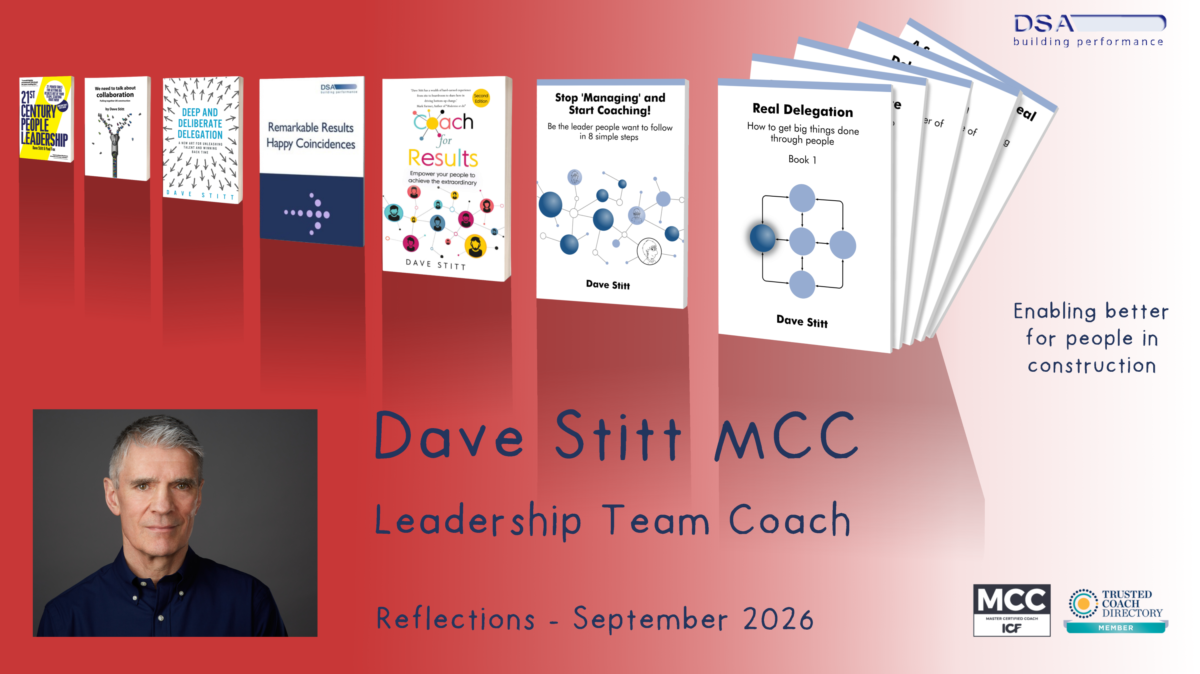
Reflections from my September LinkedIn posts on belonging, being and the effort to prove myself
After 50 years in construction, 25 of them coaching, you would think my not-good-enough would have worn off by now. It hasn’t. It’s just gone underground and become better dressed above ground.
This month I’ve been writing about impostor syndrome, though I’m still not sure that’s what to call what goes on for me. I know I’ve spent years worrying they are going to find me out. I’ve also spent years working hard, caring for the work and going the extra mile to make up for what I thought were my shortcomings. That seems to have stood me in good stead. So what, exactly, am I trying to fix?
The work nobody asked for
Mine shows up as generosity; in the extra session or the additional day. The piece of work nobody asked for and nobody was invoiced for. From the outside it looks like commitment, and much of it genuinely is, but I’m now asking a harder question of myself: am I giving this, or am I proving something?
Often, I’m proving something. The tell is that the proof never lasts. Fifty years of evidence, and it buys me about a fortnight. Worth that has to be continuously re-earned is not worth. It’s a treadmill with good reviews.
If you want to know whether this is you, don’t examine your feelings, look at your invoices. Add up the work you did that never appeared on one. Mine was not a rounding error.
Here is the part I got wrong. I thought the cost of over-giving was mine – my time, my margin, my energy. It isn’t only mine. If I do the work, the person it belongs to doesn’t have to. My extra effort unwittingly removes the consequence of someone else’s inaction, and then I’m puzzled when nothing changes. Generosity that lets people off the hook is not generosity, it’s rescue wearing better clothes.
The other place it hides is endurance. I’m good at staying with difficult things, enduring them. I do not walk away. That has served me well for five decades, but it has a shadow. If you can endure anything, you never have to ask whether something is worth enduring. “Can I stay with this?” replaces “Should I?”, and the answer to the first question is always ‘yes’.
It’s useful to notice the difference between a gap that is mine and a gap I’ve volunteered to fill. They feel identical from the inside, but they are not the same thing at all. I don’t spot any of this on my own – coaching supervision helps; it takes someone else asking me a challenging question. So I still work hard, I just check the motive more often than I used to. And I’ve stopped expecting my not-good-enough, if that’s what it is, to disappear. It’s part of the equipment.
Forty hours, including travel
Back in the 1990s, the company I worked for introduced a rule: Maximum of 40 hours a week including travel. Anything not done in that time was a Breakdown, to be carefully considered.
For someone reliant on going the extra mile to cover for a felt sense of inadequacy, this was not good news. All the stuff still to be done after the 40-hour limit was exposing, though it really did make me think about my role, what was mine and what was not, and how to delegate effectively – which I couldn’t work out at the time, though I did write a book on it many years later.
I also learnt that declaring a Breakdown, handled properly in the right culture, leads to Breakthrough and a surge of energy to go again. Onward and up. I think ‘we’ need to reintroduce Breakdown technology.
And 40 hours a week including travel – no way! Not now.
Finding my way in
Doing a bit of careers advice the other day got me thinking about mine, what I got just over 50 years ago. None from my teachers; they didn’t have a clue. The obvious choices were going down a coalmine or working in the docks. No way, either of them.
It struck me suddenly – I had not remembered this in all that time – that I did my research in the golf club car park. I’d notice what cars people had and then I’d find out what job they did. Then one day a bloke with a really nice car asked me if I wanted to be a trainee civil engineer. I asked one of the women members, who I knew to be a careers adviser, what a civil engineer was. She said it was a very good job.
Twenty years later, by then my mother-in-law, I asked her what a civil engineer was and she said she had no idea. We both had a laugh about that.
By the way, I had no advice for a young person the other day. I put their details into AI and sat with them as they thought through the options it came up with. Some I had never even heard of. Amazing really, the sum total of all careers advisers working on his case. Who knows, he and I might even end up on the same course!
Belonging and knowing enough
For the first 25 years of my career in operational construction I went above and beyond, yet I never truly felt I belonged. My worth was something to be earned, again and again. This month I’ve been wondering whether my impostor feeling has more to do with belonging than competence.
I enjoy the news. I like the intrigue and some of the personalities involved. But more and more of it is speculation about what may or may not happen, and I’ve noticed it feeds my anxiety. I cut back from time to time. Then I feel guilty, because I was always told to keep abreast of current affairs.
Current affairs worked like another way to belong. Knowing the latest felt like my ticket into the boardroom chat, the site cabin or the client lunch. Not knowing risked that awkward moment of, well, not knowing.
There’s also something I’d call borrowed confidence. Commentators speak with great certainty about things nobody knows yet. When I already wondered whether I was good enough, that confidence could make my own careful uncertainty look like a weakness. In coaching, I’ve come to see it as a strength.
I want to be more at ease with my insecurity, it has served me well. It makes me prepare, and it makes me try hard not to let people down. There’s truth in the saying that if you want something done, give it to a busy person. But I need to watch it; checking the news and checking whether I measure up have a lot in common. Both scan for the next threat, and neither ever tells me when I’ve done enough.
In my work I don’t need to be the best-informed person in the room. I believe clients have the answers, and my job is to create the conditions for good thinking. That calls for presence, curiosity and judgement, which are exactly the things that constant speculation wears down. Now I’m trying something different. I check in less often, and when I do, I look for what has actually happened rather than what someone thinks might happen. I see this as knowing enough rather than blissful ignorance.
How much news do we really need? And who told us it had to be more?

DeliverStart2Finish ™
Building and sustaining the team for the duration so it delivers remarkable results in a remarkable way.
What got me here
There’s that saying: “What got you here might not get you there.” By way of example, here’s me 30 years ago. I’m a site project manager pushing to get up the leadership ladder and, at the same time, worried they are going to find me out.
My modus operandi is drive and determination. Push, bark and bite. Encouraged behaviour in my formative years, it certainly wasn’t working now. I was stuck. I pushed harder and got more stuck. What got me here wasn’t getting me higher up that leadership ladder.
How do you know what it is about you that’s got you here? It’s probably not your qualifications nor the hours you are putting in. And what do you need to work on to get to where you want to be? Again, probably not another qualification, nor or more hours of presenteeism.
For the last four or five years, I’ve been writing a book called Advanced Influencing for Leaders and Those Who Want to Become Leaders. Shortened to AI4L – originally clickbait, but it’s stuck. In my research for the book, I developed a thing called the AI4L Self-portrait. A portrait is something you look at and a self-portrait is one you paint of yourself. It shows you what it is about you that got you here and points you towards the necessary development to move to where, or who, you want to be.
Being, doing and relationships
I listened to an author interview on the radio, checked out the book, bought it, read it, related to much of it. It’s got a nice intro-level section on ‘being’ and ‘doing’. I’m into that.
My thinking – in business, the focus is on doing. My interest as a coach is more about being: who we ‘be’ as a person or as a leadership team and who we are becoming, beginning to be. I believe that’s what really counts at the top.
A line from the book registered with me: ‘Relationships are not just a backdrop to our lives, they are the entire environment in which we live and grow’. Spot on. Our being shapes our relationships, moment by moment.
‘Not good enough’ seems to feature throughout, and I relate to that. It’s probably why I’ve always tried so hard and will never let you down.
Getting personal
At some stage you’ve got to get personal if you want to work together effectively, the earlier the better. A fun way of getting to know each other a bit better is to go round the room, each person sharing what they are listening to, reading or watching.
This reminds me of the long-running BBC Radio 4 programme Desert Island Discs. Guests share their favourite music tracks and frequently stories that shaped their lives. We get to know them a bit better. Some are surprising – the infamous rocker turns out to be a real family man. It’s hard to trust someone you don’t know, and we need to be trustworthy to collaborate effectively.
Desert Island Discs reminds me of a nice exchange I had when coaching an executive. In an attempt to promote lateral thinking I asked him, “What would you and I be doing if we were stuck on a desert island together?”
“I’d be sat on a deck chair sipping a tequila and you’d be frantically searching for a way to get us off the island.” Ha! Not sure about lateral thinking, but he knows me well.
I’d keep Radiohead’s Climbing Up the Walls from my own eight tracks. I love its intense chaos. Maybe the executive’s answer tells you why.
Being real
Recently, I’ve been wondering if I’m an over sharer. This has come up in several conversations, linked to neurodiversity, ADHD, impostor syndrome and the like. With me, I’m not sure if I am over sharing, being hard on myself or being real.
People say “let’s get real” and then talk about others, them over there, or the history, the context, or speculate over why something happened or might happen. To me, ‘real’ is what’s going on here and now in me, in you, between us. Right now.
I share what is going on for me: “I’m totally lost, frustrated with myself, not with it,” and the other person says, “Dave, you’re being hard on yourself.” No, I’m not. I’m sharing what’s going on in me right now. I’m being real. That’s the kind of real I mean: what’s happening in us and between us right now.
What’s going on in you right now as you read this? What’s going on for me right now? I’m not sure about what I am saying here … over sharing?
More to think about
I’ve long thought I’d better go the extra mile to make up for my shortcomings. Combined with caring for the work, that seems to have stood me in good stead over the years – though when my anxiety mounts, I hesitate and tip into procrastination. That also has its benefits; now I have time to think.
I’ve stopped expecting my not-good-enough to disappear. It’s part of the equipment. I’m checking the motive behind my extra effort more often and trying to notice which gaps are mine to fill.
As for whether this is impostor syndrome, I’m still wondering. I don’t want to explain away 50 years of experience with a label I’m not sure fits. I’ve got this far while feeling as I have; I’m interested in what that tells me about the work and about myself. I’m still thinking about it – and still trying hard.