
Fifty Years in Construction – Part Two: From partnering workshops to joined‑up leadership
Reflections on 25 years of independent practice – leaving Wates, Costain’s 10,000‑day journey, unlearning as a coach and the slow build of DeliverStart2Finish.
A fork in the road – July 2001
I’m halfway through my 50 years in construction. It’s July 2001. I’ve just left Wates Construction after leading their award‑winning Improving Construction Programme. It is a few years after Egan’s ‘Rethinking Construction’ report and the industry is awash with talk of ‘partnering’ and ‘best practice’.
The Wates programme was about getting things right first time. We designed an end‑to‑end process for construction projects that got parties collaborating far more closely than usual. Stage F was a project launch workshop, bringing key players together to define shared drivers and agree how they’d work together to achieve them. With previous experience of these workshops, I designed the template for what became known as the ‘F Team Meeting’. I facilitated most of the early ones and trained up a bunch of others to do likewise.
Near the end of my time with Wates, I met with the then Construction Best Practice Programme Director, Zara Lamont, and told her what I was thinking of doing next. She responded with a resounding “Yes!” and said, “That’s exactly what’s needed now, and there is no one with your construction and leading‑change experience. You will do great at that.” I left her office inspired and, on the strength of her encouragement, a 25‑year‑old contact book and a vague idea of a future career in coaching, resolved to set up my own company.
Later that afternoon, in London, we agreed the company change was sufficiently embedded and that my role in Wates was redundant. I entered a 30‑day period of formalities – ‘we’ being the MD, HR director and me. During this period, I checked in with a former boss and explored my coaching idea versus a regional director‑type job. He advised against the latter and said the coaching path was better suited to my values and integrity. We recently talked about that fork in the road and both agreed he was right.
So here I am, on 31 July 2001, facilitating the first F Team Meeting for my new company, DSA Building Performance Ltd (DSA) – registered with Companies House the day after.
Partnering workshops and a question that wouldn’t go away
The early years of DSA were steeped in ‘partnering’. The industry was three years into ‘Rethinking Construction’, inspired or pushed by the Egan report, itself one of dozens of Government reports into construction since the Second World War. Egan told us not to do the same thing a bit better, but to totally rethink how construction is done. Part of that rethink was for the parties involved to work together rather than against each other – to partner – reinforcing the spirit of the 1994 Latham report.
Partnering was in fashion and I was right among it. To tick the right box, most public sector projects needed a Partnering Workshop at the start of the job. To get on tender lists and frameworks, main contractors had to show they were doing something similar with their specialist contractors. The industry was awash with ‘friendly workshops’. These days needed someone to stand at the front and somehow get industry‑toughened professionals, often sceptical, to participate all day and sign a charter by the end of it. That someone was me. I was busy from the start.
At the same time, I was seeing how thin some of this activity was. Some months earlier, while still at Wates, I’d attended a Major Contractors Group (MCG) workshop on Quality. MCG was a trade association of the 21 biggest contractors in the UK and Wates was a member. Up to lunchtime, the facilitator had us in breakouts brainstorming on flipcharts. I thought it was pointless and knew at least one other person called Tony agreed. After lunch, as we were being set up for more of the same, I asked the facilitator: “What’s the point of this? Why are we doing this?”
He seemed stunned and came back with, “You got any better ideas, Dave?” I said yes. “We have the right people from the 21 biggest UK contractors in this room. How about we each share our company’s quality improvement strategies?” Most people nodded or smiled in approval. The facilitator said, “You go first, Dave.” I explained the programme I was leading across Wates. There were gasps, ‘wows’ and ‘follow that’ comments.
As we went around the room, it became clear – to me at least – that there was not much happening strategically across most of the other companies, with the exception of Costain, who were about to launch something big. Others talked about isolated pilots – a new snagging list in Excel on a section of a job about to be handed over. I remember thinking: is this really the sum total of quality improvement across 19 of the biggest players in UK construction?
Costain, 10,000 days and meeting everyone
At that MCG workshop, I met Tony Blanch of Costain. They had some serious change brewing and we connected over that. Some months later, after I had set up DSA Building Performance Ltd, Tony got in touch looking for someone to facilitate their company‑wide change programme. It turned out that someone was me, for something I didn’t really think of as ‘coaching’ at the time, but did for about six years.
I was thankful for the regular work, even though much of it involved standing at the front of large rooms rather than sitting in a coaching chair. My role was essentially to keep the days moving and people engaged – around 10,000 people‑days in total. I doubt there will be anything quite like it again.
Being at the front of the room for all those days meant I met everyone in Costain – literally everyone. I formed strong working relationships with many of them and went on to coach several of their business unit and project leadership teams over about 12 years. Some of those people rose up the ranks. That is deeply satisfying work, and I like to think all that engagement helped when Costain went on to be named Contractor of the Decade in 2010.
For a fledgling coaching company, it was a remarkable stroke of good fortune: one encounter at an industry workshop unfolding into a decade‑plus of substantial work with a single organisation.
An unexpected day with a main board
A different strand from the same MCG workshop involved another major UK contractor.
Several months after the session, their Quality Director invited me to come and talk with him in his office about quality, what I had done at Wates and what I was now offering through my new company. I turned up expecting a straightforward meeting with Fred – an hour, perhaps 90 minutes, of conversation. Instead, I walked into a room and realised, very quickly, that this was the main board of one of the country’s leading contractors.
The ‘chat with Fred’ turned into a full‑day session – or at least as long as we had before my flight home. Looking back, it was a story of naivety and substance in equal measure. Naivety in assuming I was only meeting Fred. Substance in discovering, in real time, that I could hold a main board engaged for an entire day on the subject of business change.
For me, that day was another confidence milestone. It reinforced that what I was offering had real weight. It also showed me that I could stand in front of senior people I had never met before, with no elaborate set‑up, and still bring enough structure, curiosity and grounded experience to keep them thinking with me rather than switching off.
The Costain work and this main‑board day started in that MCG workshop, but they led down very different paths. Both, in their own way, helped me see there was space in the industry for the kind of thing I was offering then and an appetite for the work I do now.
From one‑off days to DeliverStart2Finish
Back in the wider industry, partnering workshops continued to proliferate. To tick the right boxes, many public projects needed a one‑day event with a charter at the end. There was box ticking. There were also lots of senior project people who genuinely wanted to partner and move away from years of hostilities. Many had entered construction for good reasons, and fighting their corner every day wasn’t one of them.
While they wanted to work together, collaborate or partner, they didn’t know how in the prevailing conditions. They were looking for a framework, a process, anything that might help. I got the call and had a partnering workshop ready for them, off the shelf. So we did a one‑off, one‑day workshop and that was it. At that time, I didn’t have much more to offer by way of follow‑up.
Four or five years went by and I started to question the effectiveness of these workshops and the impact of my work. Around that time, I joined a Canadian programme called Strategic Coach, where participants got back together every 90 days. I started to wonder: perhaps I could do something at that cadence with construction teams.
So, at the end of each partnering workshop, I began asking, “What do you think we should do next?” To my surprise, there was usually someone who would shout out, “Dave, we now have a plan for the next three months – why don’t we get back together then and see how we’ve done against it?” I’d say, “OK, let’s do that,” and my DeliverStart2Finish (DS2F) team development programme was born.
I’d ask the same question at the end of the follow‑up workshop and often got the same response. We would just keep going every 90 days – rinse and repeat. Nowadays there’s more to it than that. My unit of sale is a rolling three‑month period of coaching interventions. The minimum period of work is 12 months and sometimes continues for five years.
I realised that asking a new client to commit to a year of DS2F requires a leap of faith, so I introduced a Discovery Day designed and structured to pave the way for the longer‑term programme. When construction leaders discover there is rigour and accountability, most take the leap and reap the rewards. Many years ago, I decided to position this work for the leadership teams of big business or big projects, for greatest impact. I used to work with a maximum of seven teams in parallel; after COVID, I reduced to three. Now, I mostly coach the leadership teams of billion‑pound projects or companies.
This is my work, 50 years in: moving from happy‑clappy, one‑off events to a disciplined, start‑to‑finish process that establishes and sustains leadership teams over the full life of their work together.

DeliverStart2Finish ™
Building and sustaining the team for the duration so it delivers remarkable results in a remarkable way.
Twenty‑five years of unlearning
Alongside the evolution of my programmes, there has been another thread: 25 years of unlearning what I thought coaching was.
In 1996, I was a participant in a Coaching the Coaches programme. The idea was to develop internal coaches to keep the ‘transformation’ going after the external consultants left. It was organisational development, though the executive called it transformation. Five years later, I set up my own coaching company. I then practised what I thought was coaching and did very well – much better than being salaried.
Over that period, I went on various short courses and got glimpses into how the field of coaching was developing. In 2013, I decided to formally train as a coach and joined the year‑long i‑coach academy certificate programme – a challenging study of coaching and of myself. I was now technically qualified as a coach. I thought that was that; I was a ‘proper coach’. With hindsight, I’d say that at least by then I knew what coaching was and had begun to understand what I had to unlearn and what I had to stop doing.
Unlearning is spectacularly difficult. At 50, I unlearnt my self‑taught and highly ineffective swimming stroke and started again from scratch. For over a year, I practised micro‑movements in the pool. People must have thought I was nuts. Then slowly, over weeks and months, I put the movements together to form my new stroke. Seven months in, I swam my first length. It was totally different. I went from creating huge turbulence to now, many years later, swimming calmly, almost without a flutter.
The same applied in coaching. Some of the ‘not‑coaching’ behaviours I had to unlearn were exactly what clients had previously wanted from me – answers, direction, a strong view. Some still expect that. After more short courses and deeper dives into systems‑oriented work with Coaching Constellations, I felt ready to step it up again. It was 2018. I was technically qualified but not professionally qualified. There is a difference between being a graduate civil engineer and a chartered civil engineer. The same applies in coaching.
Researching the coaching bodies, someone I trust said the International Coaching Federation (ICF) is most interested in how you are as a coach rather than what you know about coaching. I decided to go through their route and rigours. After several years of study, more practice, and supervision and mentoring, I reached the point where I could apply for Professional Certified Coach (PCC) status. Applying was a feat in itself. The final step was a crazy‑hard exam, for me anyway, which I managed to pass first time. It was December 2019; I had landed. I was a professionally qualified coach.
Soon after, and wanting to be the best coach I can possibly be, I decided to step onto the path towards Master Certified Coach (MCC) with the ICF – the global gold standard for professional coaching. Evidencing my coaching was a three‑year campaign. The standard required was off my scale. For me, MCC is so different to PCC – fundamentally different – though that’s hard to explain if you haven’t worked through it. Working with an incredibly skilled and patient mentor coach, we went through many hours of recordings of me coaching others, looking only at me, then me slowly adjusting, improving, rethinking as the months and years went by.
There are 64 competencies and you have to demonstrate all of them in one recorded coaching session – maximum duration one hour. Two recordings are required to apply. For a long time, I felt this was beyond me, though my mentor coach was steadfast. When I was stuck, someone told me: “Just submit what you’ve got, Dave, fail and learn. You get brilliant feedback when you fail. Just keep going till you pass. Put your ego aside.” That freed me up. I submitted my best two and passed first time. I was astonished. That meant I could take the exam. I prepared for three weeks solid. For me, with my peculiarities, it was a crushing exam. Somehow, I passed.
A year later, I still haven’t really celebrated. I suppose I am doing that now, here. Thankfully, I don’t have to do it again. I am MCC, or at least I have the badge. Mastery is a never‑ending journey, and 25 years in, I’m still finding new ways to grow – which is exactly what keeps me coming back to it.
Remarkable results, happy coincidences
Unlearning also changed how I made sense of my own impact.
It’s 2017. I’m 16 years into running my business and things are quiet. I haven’t raised an invoice in four months. My confidence is down. My marketing consultant asks, “Where’s your case studies?” I say, “What case studies?” She says, “You’ve been doing this for a long time, Dave. What have you been working on, who with and what impact did it make?” I say, “I’ll get back to you on that.”
The next day, I’m talking with an MD I worked with a few years earlier. He is enthusing about his company’s best year ever – profit, forward order book, awards, internal promotions, recruiting staff. At the time, it seemed everyone was talking about them, including me. We still are. Without much thought, I say, “Whoa, that’s a happy coincidence.” He looks me in the eye and asks what I mean. “I worked with you and your top team for 12 months and then you have your best year ever, awards and all kinds of successes – that’s a happy coincidence. What do you think?” He says, “Well, yes, it is. I’d never thought of that; actually, yes.”
Around that time, I’m on one of Seth Godin’s courses, The Marketing Seminar. In one module, he explores the idea that excellence is boring and ‘remarkable’ is where it’s at; to flourish, you need lots of the right people remarking about you. Back with the MD, I’m thinking, That’s a remarkable result.
In the weeks and months that followed, I went back to a dozen or so previous clients. They all seemed to be saying great things about their business results after our work together. Each time, I was thinking, That’s another happy coincidence. I wrote each up as a case study, asked if they would personally endorse it and for permission to use it for marketing. They all said yes. My print company designed a glossy brochure with the case studies as inserts. I called it ‘Remarkable Results Happy Coincidences’.
I ordered a short print run of 100 copies but never posted them. It was really for me and my confidence. Business seemed to pick up after that. I’ve since put the case studies on my website, adding to them from time to time. The brochure still sits in my office, alongside my books. It’s a reminder that, in leadership work, direct attribution is messy. Often, the best we can say is: “We did this work together and what followed was remarkable.” That’s enough.
Books, delegation and the default of command and control
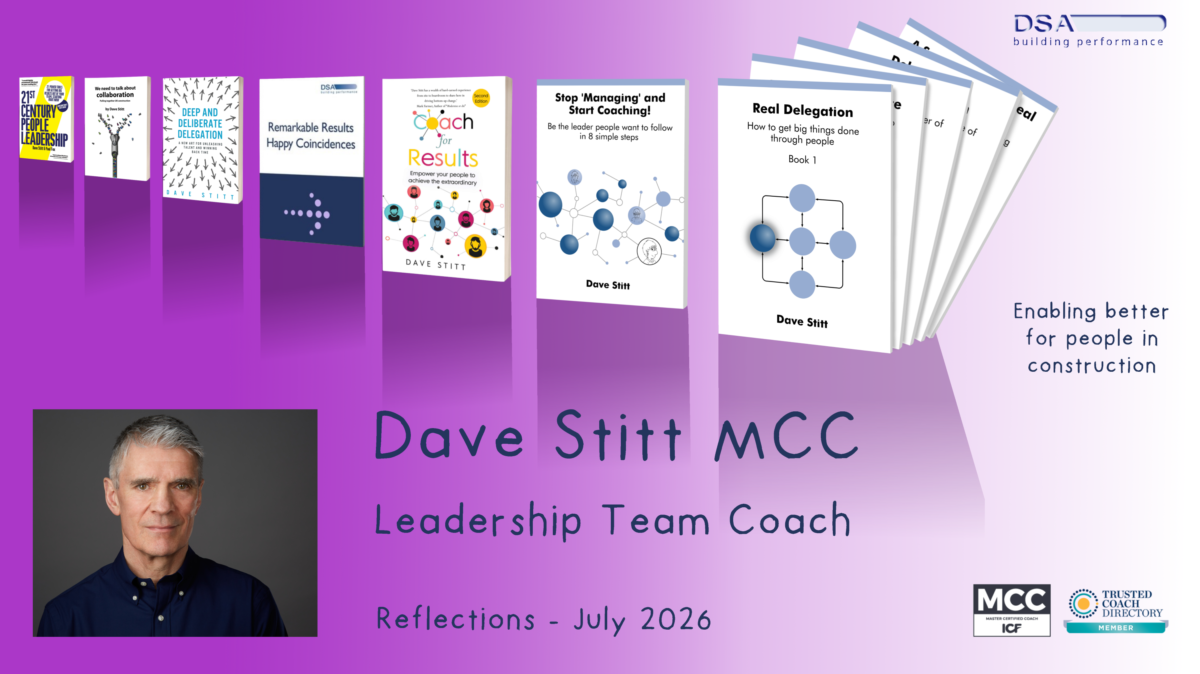
Writing has been another thread in this second half of my 50 years. I spent around six years writing blog posts, each centred on an attribute – confident, focused, happy – in a leadership context. Titles like ‘The Confident Leader’. I wrote about 50 of these and thought about a book. A colleague was doing similar, so we pooled and published together. Rod Sweet compiled, edited and managed it, and came up with the title ‘21st Century People Leadership’. Peter Woolliscroft, head of ProCure 21, wrote the foreword. I was an author.
The book did okay. People said nice things. I learned some lessons along the way – including about becoming a ‘millionaire’ from writing books. A few years later, I wrote my second, ‘We Need to Talk About Collaboration’, inspired by my favourite film, starring Tilda Swinton. The premise: the Government had been telling the industry to collaborate for years or something terrible would happen this time. I added my practitioner experience of enabling collaboration, plus methodology. I published it as a PDF, freely available on my website. I have no idea how many downloaded or read it; it didn’t change the industry.
Then came my bestseller. It’s 2015. A client asks me to run a workshop on delegation. I say, “No, I’m not a trainer.” A few weeks on, every conversation with business folk includes frustration over delegation. I realise he’s onto something. I go back and say it isn’t a workshop; it’s a course. We talk, he goes for it and we roll it out across his business. From the course, I wrote the book and, with Rod’s help, published it on Amazon in 2018. It’s sold most days since – nearly 5,000 copies. The title: ‘Deep and Deliberate Delegation’ – about unleashing talent and winning back your time.
To this day, every conversation I have with business people includes delegation. It dawns on me that the default mode of management is command and control. As a coach, I know that as soon as you tell someone what to do, they stop thinking for themselves and wait for you to tell them what to do next. Many leaders have said to me, exasperated, “Why do I have to do all the thinking round here?!” To me, the answer is obvious, and I start writing about it.
In 2022, I publish ‘Coach for Results’, again with massive credit to Rod – so much more than an editor. The idea is to get young people adopting coaching skills into how they manage and get things done through people – and to do that at scale, changing the industry from the ground up. Some at the top also realise command and control doesn’t work and want to re‑chip their approach. It’s a short read. Four years on, sales are slow. A few blame the word ‘coach’ in the title – but honestly, I think it’s more down to my own lack of marketing, plus the fact that command and control is alive and kicking. Still, I reckon it’s my best book so far.
Speaking plainly about joined‑up leadership
All of this – Wates, partnering, Costain, that main board day, DS2F, unlearning, books – has shaped how I now talk about what I do.
I work with big business and big project leadership teams in the construction industry. At my entry point, these talented team members have different drivers and are working in silos. They say they are a good team – “we get on fine”. But messaging is mixed and uncoordinated. Some tell me they are working below their pay grade and want to step up and lead together rather than ‘do’ on their own.
If nothing changes, it will cost them in personal frustration, widespread confusion, disengagement through the ranks, sometimes a toxic environment, fading commitment, low morale, staff churn, poor productivity, claims and counter‑claims, disappointing results, stalled careers and worse. If nothing changes, it is more of the same. The job will get built, though it is bruising.
Through my coaching, they become joined up as a leadership team, pointing in the same direction and leading accordingly. And because my team coaching is a process rather than an event, they work on sustaining their collective effectiveness from start to finish. When they follow the process, do the work and stay the course, they deliver remarkable results in a remarkable way. Lots of the right people remark about them. Their reputation for delivery is enhanced and many go on to realise and even surpass their career aspirations. I’ve been around long enough to witness it.
For my clients, that is worth millions, enhanced company brand and personal reputation, career success and legacy. For regional directors, project directors and CEOs, it also means more control, more balance in their lives and stronger confidence in their leadership team. For team members, this is a big opportunity that few will ever get.
If you are leading or are in a team that feels a bit off, or are about to embark on something magnificent and want to nail it, then I’m speaking to you. Not with a promise of so-called ‘transformation’, but as someone who has been in the industry for 50 years, the last 25 as a leadership team coach, and who still sees this work as a partnership – a steady, thinking partnership – rather than an expert handing down answers.
Next up – sport and 50 years an imposter
I have been reflecting on 50 years in construction split equally between operations and coaching. There have been some constants through all those years. One being my lifelong pursuit of sport and fitness, another my feeling of being an imposter about to be found out at any moment.
My sport and fitness has been intricately woven into my work and vice versa. I’m reflecting on this next, then maybe we will touch on 50 years an imposter. They haven’t found me out yet, or have they?