
Expecting the Word to do the Work
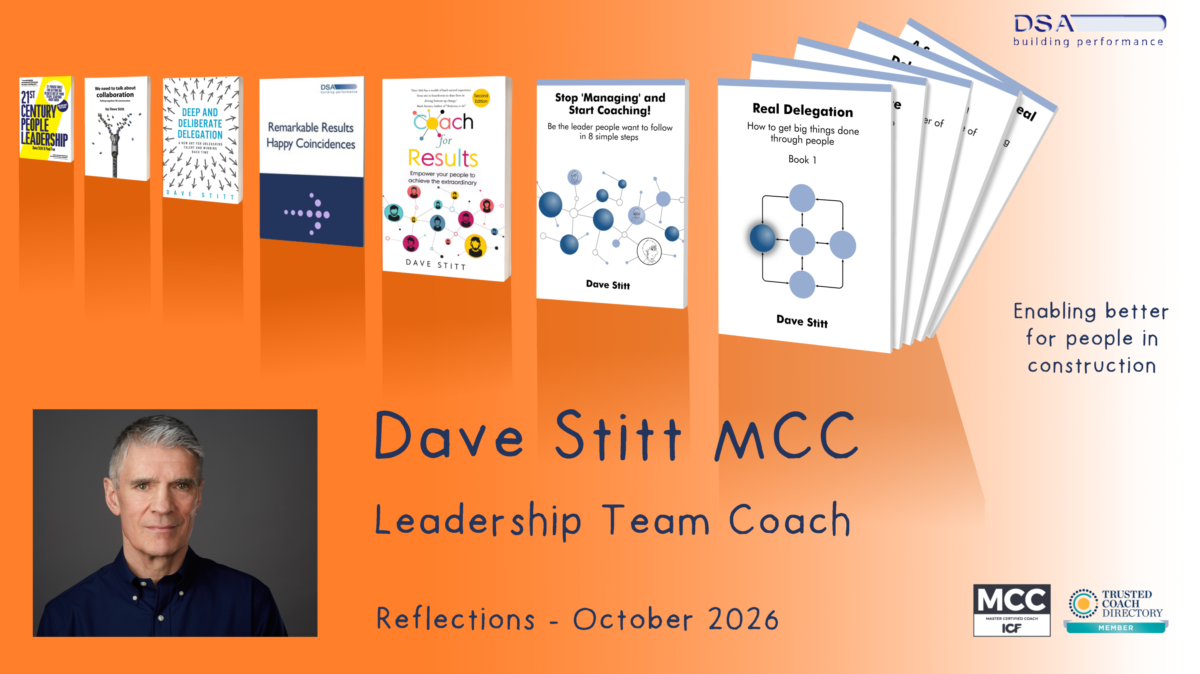
Reflections from my October LinkedIn posts on words, what we mean by them and how we work together
Over my 50-year career, I’ve developed a love for understanding words at a deeper level, growing my understanding from definition to distinction. I’m a bit nerdy about words. When I come across a word being used in a significant situation, I like to dig into it: where it comes from, the root of it, what it means and, as a coach, how we might use it in a useful, substantive way, so that it becomes a tool to guide behaviour and get things done.
Construction is full of words like collaboration, partnering, transformation, alignment, accountability, responsibility, cohesive and integrity. We use them as if everyone understands and agrees what they mean, though when I ask people what they mean by them, that is often far from clear.
It’s as if we expect the word to do the work. For example, keep mentioning ‘collaboration’ and somehow, we expect to find ourselves collaborating, even though the behaviours and expectations that would make it happen haven’t been agreed. Everyone recognises the word, everyone can join in the conversation and everyone can leave the room believing they’ve agreed something, when perhaps all they’ve agreed is the word.
A different kettle of fish
This month, I was asked to do a talk on one of my books: ‘Deep and Deliberate Delegation’. Easy, I could talk about it all day: the back story, how I researched and brought it together, the course that goes with it, how much I spent on both and how much I’ve made – the difference is big, though not the way you’d want it.
Then I could explain the model I created, the content in detail, some case studies, funny stories, insights, tools and lessons. I could talk about it all day, but I had an hour.
Then I saw what had been sent to my audience. It was billed as a masterclass. Now that is a different kettle of fish. All of that information becomes background. The focus moves to their practice, and the audience become participants.
As I prepared for this masterclass, I was counting on them to have read and reflected on the book. They would bring views, challenges, experiences and expectations leaning towards mastery, and they would come prepared to participate. There would be questions I’d be asking them – leading to new thinking and dialogue. Bring it on.
Delegation is a capacity and capability issue. There is a lot riding on how well we do it. The bar is high. There is follow-up work; mastery takes longer than a one-hour session.
I was looking forward to it, excited about the conversations and learning from some of the masters in the room.
Counting on
The word ‘accountability’ is a good example. In my earlier construction career, it was the noose around my neck by which I was going to be hung if the project I was leading didn’t work out right. It sat with me as a huge burden.
My first coach, 30 years ago, got me to look at how the word was made up and I settled on a meaning that worked for me: counting on. My boss was counting on me to deliver the project according to certain success criteria, and he’d hold me to account for my progress, which simply meant that I’d give him an account of how I was getting on.
With that understanding, accountability moved from being a huge burden to clarity and liberation. I was clear about what was expected of me and happy to explain, at regular intervals, how I was getting on. That’s how I’d like to see the word used; it works much better than the fuzzy, fear-inducing application I came across then and still encounter now.
I’ve asked leadership teams many times over the years about the difference between responsibility and accountability. The question usually leads to confusion and disagreement. People have different understandings of both words, and it often becomes clear that they’ve been using them for years without discussing what they mean or agreeing the difference between them.
For me, there’s something useful in seeing responsibility as being able to respond, and accountability as knowing who is counting on you and for what, and being willing to give an account of how you are doing. The important part for a leadership team is having the conversation and reaching an understanding that works in their situation.
‘Cohesive’ is another word I hear used loosely in the construction circles I mix in. When I ask, “What do you mean by cohesive?” I sometimes get vacant looks, followed eventually by, “You know, Dave, cohesive!”
Definition and distinction
My ‘Nerd’ post led to an exchange about ‘collaboration’ and ‘cooperation’. Dr Susan Dawson said that even the dictionary definitions offer a subtle distinction between the two, which got me thinking about the distinction between definition and distinction.
I could talk for ages about distinction “distinction”. A definition tells us what a word means, distinction enables us to see more in it and, with that richer understanding, do something differently or better.
Take golf. Someone who knows little about it may see a person hitting a ball with a club. A golfer sees a drive, draw, fade, hook, slice, chip, pitch or putt. They notice the lie, stance, clubface, wind, ground conditions and probably a dozen other things I have missed. That distinction (distinction golf) has been developed through years of experience and affects what the golfer does next.
I think the same applies to the important words we use in business and construction. A dictionary definition of ‘collaboration’ will tell us something about working together to create or achieve something, which is useful, though it doesn’t take us very far when we’re trying to collaborate on a difficult project where the parties have different interests, risks, pressures and contractual positions.
A richer distinction of ‘collaboration’ might include how we make decisions, share information, deal with disagreement, allocate risk, respond when things go wrong and work through the inevitable occasions when our interests pull us in different directions. It might include trust, cooperation and competition, and how each affect what becomes possible between us. It will inform how we respond in the moment and every moment.
So, agreeing a definition is the start. Developing a useful distinction takes much more thought and conversation. More conversation brings other benefits too, including getting to know the people involved better and building trust between them.

DeliverStart2Finish ™
Building and sustaining the team for the duration so it delivers remarkable results in a remarkable way.
What I’d left unclear
I listened to two blokes talk about collaboration this month. Their conversation lasted over half an hour. It had all the buzzwords, platitudes and exhortations – behaviour was mentioned many times. When one of them eventually named a few ‘collaborative behaviours’ they were not behaviours at all – they were outcomes. If I had been in the room, I would have asked him about the doing thing (must contain a verb) that when done regularly leads to that outcome.
I also got an email from a professional body using the words ‘mentor’ and ‘coach’ interchangeably as if they meant the same thing – they don’t. Does any of this really matter or am I just a nerd?
I’m nerdy about words, but I know from experience how difficult communication can be. When I was a manager, I’d worked it out in my head but often found it difficult to explain clearly. I was always under pressure and in a rush, so I would sometimes resort to the polite equivalent of “just effing do it”. Some more experienced people just knew what was needed, while less experienced people or experienced people facing something new needed a better explanation from me.
Poorly briefed, they would go off and get into activity, wondering what they were supposed to be producing, whether they were on the right track, hesitating, procrastinating and working with low confidence and low productivity. After the due date, I’d ask, “Where is it? How are you getting on with it?” They would deflect or sheepishly show me, and I’d tell them, “That’s all wrong.”
My communication is the response I get. It took me a long time to understand that. The more experienced people had been compensating for my poor communication; their experience enabled them to fill in the gaps. The less experienced people exposed what I’d left unclear.
So, when we say we need better collaboration, more accountability or stronger leadership, what do we mean? What would we expect to see people doing, and what are the behaviours and expectations we need to agree? Sending the same words around a room, putting them in a strategy or repeating them at every project meeting does not mean that the meaning has become common.
Best practice, no mavericks
When things are off, we often reach for ‘best practice’. Those of us who’ve been around for a while have come across best practice programmes intent on improving company performance and results. There was even a Construction Industry Best Practice Programme. I’ve been involved in several; some were described as foundational many years later, even award-winning, which is good, but ….
Best practice works well when things are known, simple and clear. How often do we come across that these days, at least at organisational level? I’d argue never. So, how far can best practice take us? Well, some of the way, though it’s difficult to implement and sustain at scale, and incredibly expensive.
Part of the trouble is it relies on compliance – everyone doing what has been judged to be best practice. No departures, no mavericks, please. I’ve long struggled with the notion of compliance; to me it suggests ‘do as you are told, I know best’. Getting everyone to fall in line with that when you have independent actors (human beings) is very challenging, to say the least. The not-so-subtle approach is often ‘training’, incentives and consequences.
During October, I noticed on LinkedIn that Dave Snowden is publishing a ‘Field Guide’ on his fascinating Cynefin framework. This enables us to decide the most appropriate response to the nature of our situation. It includes best practice if it’s simple and straightforward and also ways to move forward when things get complicated, complex and chaotic. And, I think, when it’s hard to decide which and what’s what.
As soon as Prime
The new artwork on the Amazon Delivery van cracked me up – The P in ASAP stands for ‘Prime’. And then I wondered if it was actually quite clever. Does it set the benchmark in business – ‘As Soon As Prime’ – like next day?
The book I read on how to organise and facilitate a big conference said that it takes six months. And then someone rang me and asked me to design, organise and facilitate their conference for 120 industry experts in three weeks’ time, straight after Christmas – and we did it.
I thought that was going some, but next day, nah! Can’t be done. And there’s my fixed mindset, right there! Anyway, could you deliver what you deliver as soon as Prime?
And then it struck me. We ran out of bread and he said, “Dave, Uber Eats” and it was delivered in 20 minutes. Woah! Way faster than Prime. Amazing.
I don’t facilitate big conferences these days. There’s your fixed mindset again, Dave. But I actually really enjoyed doing them … maybe ….
Coming through stronger
It’s our turn now. We’ve been asked to buy bottled water, beans, Spam and corned beef in case of emergency. Measures for personal resilience. Each of us doing that, apparently, adds to the nation’s resilience. Seems sensible, I suppose. Feels like the 1980s ‘vibe’ of taking responsibility for yourself, which is a bit ironic, since we’re told it’s the 1980s that got us into this situation. Anyway, it’s the word ‘resilience’ that I am interested in here, rather than the politics.
In what I think is a masterpiece, ‘Anti-fragile, Things that Gain from Disorder’, the author Nassim Nicholas Taleb explains a difference between resilience and antifragility. With resilience, we come through disorder unchanged; antifragility has us stronger.
I’m curious about antifragility for me and for my coaching clients. What would have me come through such an emergency stronger, gaining from that disorder? I don’t think Spam is going to do it. Spam as in the canned meat product, not spam email. And the same for your organisation?
It can be done. I started coaching a leadership team a week after Boris first told us to lock down. Two years later, they were way stronger – had their two best consecutive years ever by some considerable margin. They did the work and delivered the results. Not me.
It’s a conversation. What can we do now to Gain from Disorder? If we are dashing around with day-to-day delivery, always urgent, we might never get to talk about what’s important. Back to politics … maybe they have just put important on our radar?
I’m on my way back from injury myself. This month, I did my first 60 minutes’ continuous row. Target pace 2:21, actual 2:20.9 minutes per 500 metres. Normally an easy pace but I put in five two-minute testers at 1:50 pace, every 10 minutes. That made it a just under a ‘hard’ workout. My heart rate in the last two-minute jobbie was 181bpm, so pretty hard.
As a coach I notice things. I sweat slightly more on my right-hand side and wonder if there’s an imbalance in my alignment, or if I’m slightly favouring my right-side effort. Not sure. I could be overthinking it, though improvement comes from self-awareness and noticing indicators is useful.
I’m going to keep building up for the next three months and then start racing again in the new year. Though different this time around, coming back stronger and fitter. At least that’s the plan. Maybe that’s me being anti-fragile?
Simple, not simplistic
Reading back through what I’ve written this month, I think this is relevant to my work and to my industry. For me, part of mastery is understanding something so deeply that you can explain it well in simple terms. A more surface-level understanding can lead to a simplistic explanation, and listening to it you may still not understand what is involved.
We frequently use big words like ‘collaboration’ without a deep and shared understanding of them, and end up expecting the word to do the work, which it obviously cannot do. Perhaps this is a cause of dysfunction, a cause of low productivity in our working relationships. It also suggests an improvement opportunity available to us, providing we do the work.
That work goes beyond agreeing a definition. It means exploring what we each understand, developing a richer distinction and agreeing the behaviours and expectations that would make it happen in our situation. My interest in words is part of how I now work with clients: how we might use them in a useful, substantive way, so that they become tools to guide behaviour and get things done.
My world views
About four months ago, prompted, as I remember it, by something I was reading in a Seth Godin book, I wrote down how I see the world in relation to my work as a leadership team coach. I came up with several short statements, then put the document aside because I wasn’t quite sure what to do with it.
Reflecting on all this brought me back to the document and I wondered: how does that experience influence the way I work with my clients today?
Reading those five statements again, I can see things I would explain differently and things I have left out. Trust, for example, which has filled my brain recently writing my latest book on it.
One of my statements was that most people are trying to do well. That belief matters when I’m working with a leadership team. When something isn’t working, it encourages me to be curious about what is happening, what people understand and what they are trying to achieve.
As their coach, I still need to challenge and support them, and I need to understand enough about what is happening to do that usefully. It also gives me a way of examining my own practice. If I say I believe people are trying to do well, how does that show up when I am frustrated or finding someone or something difficult?
You could try something similar. Write down three things you believe about people and working together. Choose one and ask yourself: if someone watched me lead my team for a week, what would they see that reflected this belief? For example, if you believe people should take responsibility, what happens when someone makes a decision you would have made differently? How you respond is something your team can see and experience.
I will be asking myself these questions as I revisit my other statements on how I see the world in relation to my work. During November, I’m going to share what I come up with: how I see leadership teams, where those views have come from and how they influence my coaching. I’ll bring the posts together into a longer article at the end of the month.
I’ve spent time this year looking back over my 50-year career so far. Now I want to explore how that experience shapes the work I do next. Writing down what I believe gives me something to examine, including whether my clients would recognise it in the way I work.